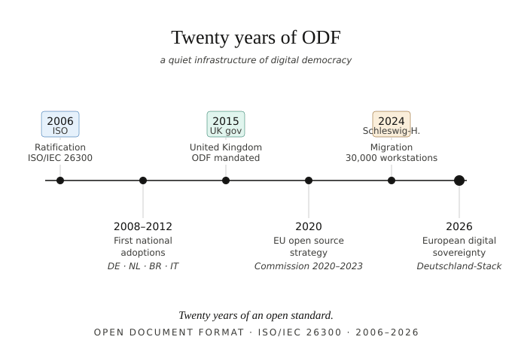
Dear office suite users, In recent days you will have read various articles announcing the arrival of Euro-Office, which is being “marketed” as the first open-source office suite developed in Europe. We feel compelled — reluctantly, since open source should rest on transparency, not deception — to correct this claim. The first open-source office suite developed in Europe was OpenOffice.org in 2001, based on StarOffice’s source code, followed by LibreOffice from 2010. These are two genuine open-source office suites, built from source code that originated in Europe. They are not a freeware clone of MS Office whose code provenance is undisclosed, nor a product that has rebranded itself out of pure opportunism to ride today’s wave of Digital Sovereignty. It is worth remembering that many of those who champion Digital Sovereignty today were silent back in 2006, when the open ISO/IEC ODF standard — the pillar of Digital Sovereignty — was announced: not only did they not listen to us during all these years, but in some cases they greeted us with a condescending smile. If we can speak of Digital Sovereignty in Europe today, it is thanks to The Document Foundation and LibreOffice community members at large, who kept
The format is standardised. It might not be a standard you like, but it’s a standard that the US can’t “take away” from the EU. Microsoft, especially in cloud form, can remove access to Office tomorrow if they’re pressured to by the US government.
We might have a desire for better file formats. The EU doesn’t give a monkey about our crusade, it purely cares about not having US leverage hanging over them like a sword. And the underlying file formats, exactly because it’s a ISO standard (however poor it may be) is fine for this purpose.
It’s not a fine standard. Microsoft filed it with the express goal of preventing ODF from becoming the prevailing document standard, not with the goal of documenting OOXML. It’s intentionally obfuscated and kept different from MS Office. It’s not a standard it’s a red herring.
And Adobe PDFs are not the same as PDF/As and yet somehow the world still turns and PDF readers of all sorts find their way around.
I’m not saying OOXML is a great standard. I’m saying it’s a fine standard for the specific purpose of having a format that Microsoft can no longer claim IP rights over, so that should Microsoft suddenly feel pressurised to remove Office functionality from Europe, Europe still has a workable solution that’s compatible and interchangeable with the 99.9% of all editable document files sent around.


The EU wants to not depend on US software.
The format is standardised. It might not be a standard you like, but it’s a standard that the US can’t “take away” from the EU. Microsoft, especially in cloud form, can remove access to Office tomorrow if they’re pressured to by the US government.
We might have a desire for better file formats. The EU doesn’t give a monkey about our crusade, it purely cares about not having US leverage hanging over them like a sword. And the underlying file formats, exactly because it’s a ISO standard (however poor it may be) is fine for this purpose.
It’s not a fine standard. Microsoft filed it with the express goal of preventing ODF from becoming the prevailing document standard, not with the goal of documenting OOXML. It’s intentionally obfuscated and kept different from MS Office. It’s not a standard it’s a red herring.
And Adobe PDFs are not the same as PDF/As and yet somehow the world still turns and PDF readers of all sorts find their way around.
I’m not saying OOXML is a great standard. I’m saying it’s a fine standard for the specific purpose of having a format that Microsoft can no longer claim IP rights over, so that should Microsoft suddenly feel pressurised to remove Office functionality from Europe, Europe still has a workable solution that’s compatible and interchangeable with the 99.9% of all editable document files sent around.