I took a deep breath before writing this. Just so you know. I understand what I’m getting myself into. Again.
But no. They’re not.
This is conspiracy thinking dressed up as insight.
They’re not spending hundreds of billions of dollars building AI data centers because they secretly want to create a “digital prison.” They’re building them because they expect them to generate hundreds of billions in future profits. It’s an investment in compute infrastructure, not some grand surveillance plot.
If governments or corporations want to surveil people, they already have far cheaper and more effective ways of doing it than constructing massive AI clusters.
Posts like this don’t inform anyone or encourage serious discussion. They just replace evidence with paranoia and drag the quality of the platform down.
One need not exclude the other, and the thinking is not based just on tin-foil-hat conspiracy theories.
Has anyone said this type of thing? Mostly no, but we do know that places like China and Russia have already implemented similar systems.
We also see trends toward software as a service, cloud-based computing, digital ID laws, and a slew of ongoing anti-competitive and anti-consumer practices over the last two years.
Again, no one has said that this is a plan, but if you told me that half a dozen billionaires were pushing it, I wouldn’t be surprised. Any one of those things would be frustrating, but all of them at once? For most of these people, the goal is likely just “make line go up,” but when that line inevitably goes down, what you have is a collection of infrastructure that is almost perfect for digital surveillance and control, not just software, but the internet at large.
I agree that most of this is just late-stage capitalism at work, but most of us here are pretty savvy. We’re mostly in the tech, engineering, or finance sectors. We all have 20+ years of chronic online time, we self-educate, and we’ve watched the world change in fine detail over the last 20 years. It doesn’t matter what the powers that be are saying. It matters what they’ll have the capability to do when the AI bubble bursts, and what modern history, especially Russia, has taught us about market and state collapse.
Personally, I do think that some big players are doing this intentionally. The AI bubble is hurting the personal computing and hobby PC-building industries, and if any of these data centers actually get built, they can easily be bought out or taken over by something like Microsoft.
Market volatility doesn’t just mean some people’s pensions get wiped out. It means market change, asset transfers, and consolidation. Even without a data center being built, if the hardware has been built and it falls into Google, Amazon, or Microsoft’s lap after a bubble bursts, then that’s vertical integration and market capture.
There may not be money in AI, but everyone caught up in the frenzy is helping to push us toward a surveillance state, even if no one has said as much.
And it’s not cool to ignore which way the water is flowing because people are panicking as we approach that waterfall in the distance.
Granted, we’re talking about factors that I can’t fully predict, but we do seem to be seeing heavy short- and mid-term investment in a restructuring of computing, and no one is talking about it because it is all being done in the shadow of AI and whatever political distraction is happening that day.
I know this is meandering, but my point is that we are moving in a very specific technological direction, even if not everyone with a hand on the wheel is driving toward the same goal. They’re all pushing in the same direction (minus a few zigzags, obviously).
It’s not a conspiracy to sound a major alarm about these things when we know for sure that the next hundred years are going to be devastating from a climate perspective. There is going to be some dark shit that happens, and I don’t really know what that will be, but I guarantee that if I can see it, and all of the experts can see it, then someone with a security clearance and a budget has seen it too.
The problem is that “could happen” is doing an enormous amount of work here.
Almost anything could happen. The existence of a capability isn’t evidence that it’s the intended outcome or even the most likely one. It’s reasonable to discuss risks and how technology can be misused, but it’s a mistake to treat possibility as probability.
The world is usually far less spectacular than the elaborate scenarios people imagine. Most of the time, the explanation is simply incentives, competition, bureaucracy, and companies chasing profits, not a coordinated march toward some grand end state.
We should absolutely be wary of surveillance, anti-competitive behavior, and excessive centralization. Those are real concerns. But once the argument becomes “they’re building infrastructure that could someday be used for X,” you’ve entered speculation. Capability alone isn’t evidence of intent, and it certainly isn’t evidence that such an outcome is inevitable.
Please, > 20 years ago, aurora colorado, built a license plate tracking system they installed in most light controlled intersections. Specifically with the intention of tracking every vehicle within city limits. There is no paranoia there, all these jurisdictions say this shit out loud, and have for decades. All the police marketers trumpet they’ll be able to track people with facial recognition, out loud, and for years. Efficacy aside, they’re drooling over it. Out loud, in marketing materials, statehouses, and newspapers for years upon years.
I’ve addressed this license plate scanner thing way too many times.
This has been a known fact for decades, as you yourself mentioned. License plate scanners are already used everywhere. Home Depot is a particularly egregious example.
Which is exactly why I said there are much easier ways to track us than building AI data centers.
Did you actually read what I wrote, or are you responding to what you assumed I said?
You’re masquerading as knowledgeable. Plate scanners have been motion triggered in the past, with text ocr scanning for plates, followed by manual review for confirmation. “AI” increases throughput and allows fast finding of more selective visual data automatically. Like this: https://lemmy.world/post/49325290?scrollToComments=true
Computer vision goes way past the old plate scanners. They are using pkate scanners for what you say they aren’t, with the technology you say they aren’t using.
Did you actually read what I said, and see what you wanted, or are you a shill?
That aside digital surveillance prison already exists. Google, Meta, Amazon etc. know enough about their users to build a complete day-by-day activity list with high accuracy. Phones listen constantly, Windows logs all you do on their servers, the dystopian tech is already there. Whet most dystopian predictions missed is that instead of endless rows of Secret Service officers watching you, it’s the advertisers who want to milk your attention.
Dystopian police state will start when police starts offering money for reporting crimes. Then all this data will pour into their hands, neatly tagged, packaged and sold.
I think he achieved a lot, and made a huge difference to many people. He can’t change the whole world, but naking a personal sacrifice to bring abuse to light is a good thing.
What they are more likely building is regional processing centers. Meaning most people have a tablet, a laptop, and a phone. All with ram, silicone, memory, and resources that sit the majority of the time. The phone gets more usage. But what if those tools were access points to a larger computer that did the processing for you? What if meant instead of having a stronger chip on your phone you just had sufficient speed of transfer for a larger computer to do the processing?
That would reduce the production costs of everything. Be easier to manage the supply chain, require fewer rare earth minerals
AND they can control/monitor all of the throughput? Security against enemies.
Yup. Once they have crested a point of adoption they are okay with. They don’t even need 50% of the population. They just need to split the room enough that we group ourselves according to arrow’s fallacy.


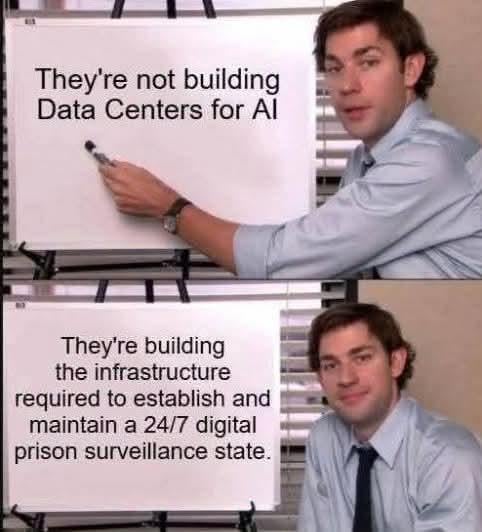
I took a deep breath before writing this. Just so you know. I understand what I’m getting myself into. Again.
But no. They’re not.
This is conspiracy thinking dressed up as insight.
They’re not spending hundreds of billions of dollars building AI data centers because they secretly want to create a “digital prison.” They’re building them because they expect them to generate hundreds of billions in future profits. It’s an investment in compute infrastructure, not some grand surveillance plot.
If governments or corporations want to surveil people, they already have far cheaper and more effective ways of doing it than constructing massive AI clusters.
Posts like this don’t inform anyone or encourage serious discussion. They just replace evidence with paranoia and drag the quality of the platform down.
One need not exclude the other, and the thinking is not based just on tin-foil-hat conspiracy theories.
Has anyone said this type of thing? Mostly no, but we do know that places like China and Russia have already implemented similar systems.
We also see trends toward software as a service, cloud-based computing, digital ID laws, and a slew of ongoing anti-competitive and anti-consumer practices over the last two years.
Again, no one has said that this is a plan, but if you told me that half a dozen billionaires were pushing it, I wouldn’t be surprised. Any one of those things would be frustrating, but all of them at once? For most of these people, the goal is likely just “make line go up,” but when that line inevitably goes down, what you have is a collection of infrastructure that is almost perfect for digital surveillance and control, not just software, but the internet at large.
I agree that most of this is just late-stage capitalism at work, but most of us here are pretty savvy. We’re mostly in the tech, engineering, or finance sectors. We all have 20+ years of chronic online time, we self-educate, and we’ve watched the world change in fine detail over the last 20 years. It doesn’t matter what the powers that be are saying. It matters what they’ll have the capability to do when the AI bubble bursts, and what modern history, especially Russia, has taught us about market and state collapse.
Personally, I do think that some big players are doing this intentionally. The AI bubble is hurting the personal computing and hobby PC-building industries, and if any of these data centers actually get built, they can easily be bought out or taken over by something like Microsoft.
Market volatility doesn’t just mean some people’s pensions get wiped out. It means market change, asset transfers, and consolidation. Even without a data center being built, if the hardware has been built and it falls into Google, Amazon, or Microsoft’s lap after a bubble bursts, then that’s vertical integration and market capture.
There may not be money in AI, but everyone caught up in the frenzy is helping to push us toward a surveillance state, even if no one has said as much.
And it’s not cool to ignore which way the water is flowing because people are panicking as we approach that waterfall in the distance.
Granted, we’re talking about factors that I can’t fully predict, but we do seem to be seeing heavy short- and mid-term investment in a restructuring of computing, and no one is talking about it because it is all being done in the shadow of AI and whatever political distraction is happening that day.
I know this is meandering, but my point is that we are moving in a very specific technological direction, even if not everyone with a hand on the wheel is driving toward the same goal. They’re all pushing in the same direction (minus a few zigzags, obviously).
It’s not a conspiracy to sound a major alarm about these things when we know for sure that the next hundred years are going to be devastating from a climate perspective. There is going to be some dark shit that happens, and I don’t really know what that will be, but I guarantee that if I can see it, and all of the experts can see it, then someone with a security clearance and a budget has seen it too.
The problem is that “could happen” is doing an enormous amount of work here.
Almost anything could happen. The existence of a capability isn’t evidence that it’s the intended outcome or even the most likely one. It’s reasonable to discuss risks and how technology can be misused, but it’s a mistake to treat possibility as probability.
The world is usually far less spectacular than the elaborate scenarios people imagine. Most of the time, the explanation is simply incentives, competition, bureaucracy, and companies chasing profits, not a coordinated march toward some grand end state.
We should absolutely be wary of surveillance, anti-competitive behavior, and excessive centralization. Those are real concerns. But once the argument becomes “they’re building infrastructure that could someday be used for X,” you’ve entered speculation. Capability alone isn’t evidence of intent, and it certainly isn’t evidence that such an outcome is inevitable.
Speculation and preventative measures are absolutely nescessary, im sorry
I think when you say speculation, what you really mean is skepticism.
maybe im quite comfortable with the knowledge that I need to make decisions under uncertainty, not just hunches, the foot needs to be placed forward
Please, > 20 years ago, aurora colorado, built a license plate tracking system they installed in most light controlled intersections. Specifically with the intention of tracking every vehicle within city limits. There is no paranoia there, all these jurisdictions say this shit out loud, and have for decades. All the police marketers trumpet they’ll be able to track people with facial recognition, out loud, and for years. Efficacy aside, they’re drooling over it. Out loud, in marketing materials, statehouses, and newspapers for years upon years.
I’ve addressed this license plate scanner thing way too many times.
This has been a known fact for decades, as you yourself mentioned. License plate scanners are already used everywhere. Home Depot is a particularly egregious example.
Which is exactly why I said there are much easier ways to track us than building AI data centers.
Did you actually read what I wrote, or are you responding to what you assumed I said?
You’re masquerading as knowledgeable. Plate scanners have been motion triggered in the past, with text ocr scanning for plates, followed by manual review for confirmation. “AI” increases throughput and allows fast finding of more selective visual data automatically. Like this: https://lemmy.world/post/49325290?scrollToComments=true
Computer vision goes way past the old plate scanners. They are using pkate scanners for what you say they aren’t, with the technology you say they aren’t using.
Did you actually read what I said, and see what you wanted, or are you a shill?
That aside digital surveillance prison already exists. Google, Meta, Amazon etc. know enough about their users to build a complete day-by-day activity list with high accuracy. Phones listen constantly, Windows logs all you do on their servers, the dystopian tech is already there. Whet most dystopian predictions missed is that instead of endless rows of Secret Service officers watching you, it’s the advertisers who want to milk your attention.
Dystopian police state will start when police starts offering money for reporting crimes. Then all this data will pour into their hands, neatly tagged, packaged and sold.
Was about to say this: It is already pretty much here and Edward Snowden showed that it was kinda already there 10 years ago, at least in some form.
Snowden was a naive intellectual who thought that if americans knew they are getting fucked they would do something about it.
I think he achieved a lot, and made a huge difference to many people. He can’t change the whole world, but naking a personal sacrifice to bring abuse to light is a good thing.
What they are more likely building is regional processing centers. Meaning most people have a tablet, a laptop, and a phone. All with ram, silicone, memory, and resources that sit the majority of the time. The phone gets more usage. But what if those tools were access points to a larger computer that did the processing for you? What if meant instead of having a stronger chip on your phone you just had sufficient speed of transfer for a larger computer to do the processing?
That would reduce the production costs of everything. Be easier to manage the supply chain, require fewer rare earth minerals
AND they can control/monitor all of the throughput? Security against enemies.
oh you mean the jerking off plot of silicon valley.
In a perfect world this sounds fantastic, but it will most certainly be exploited.
You know… Because people.
Oh yeah, this will totally only be used altruisticly. No funny business.
that’s when they take the discs away
Yup. Once they have crested a point of adoption they are okay with. They don’t even need 50% of the population. They just need to split the room enough that we group ourselves according to arrow’s fallacy.