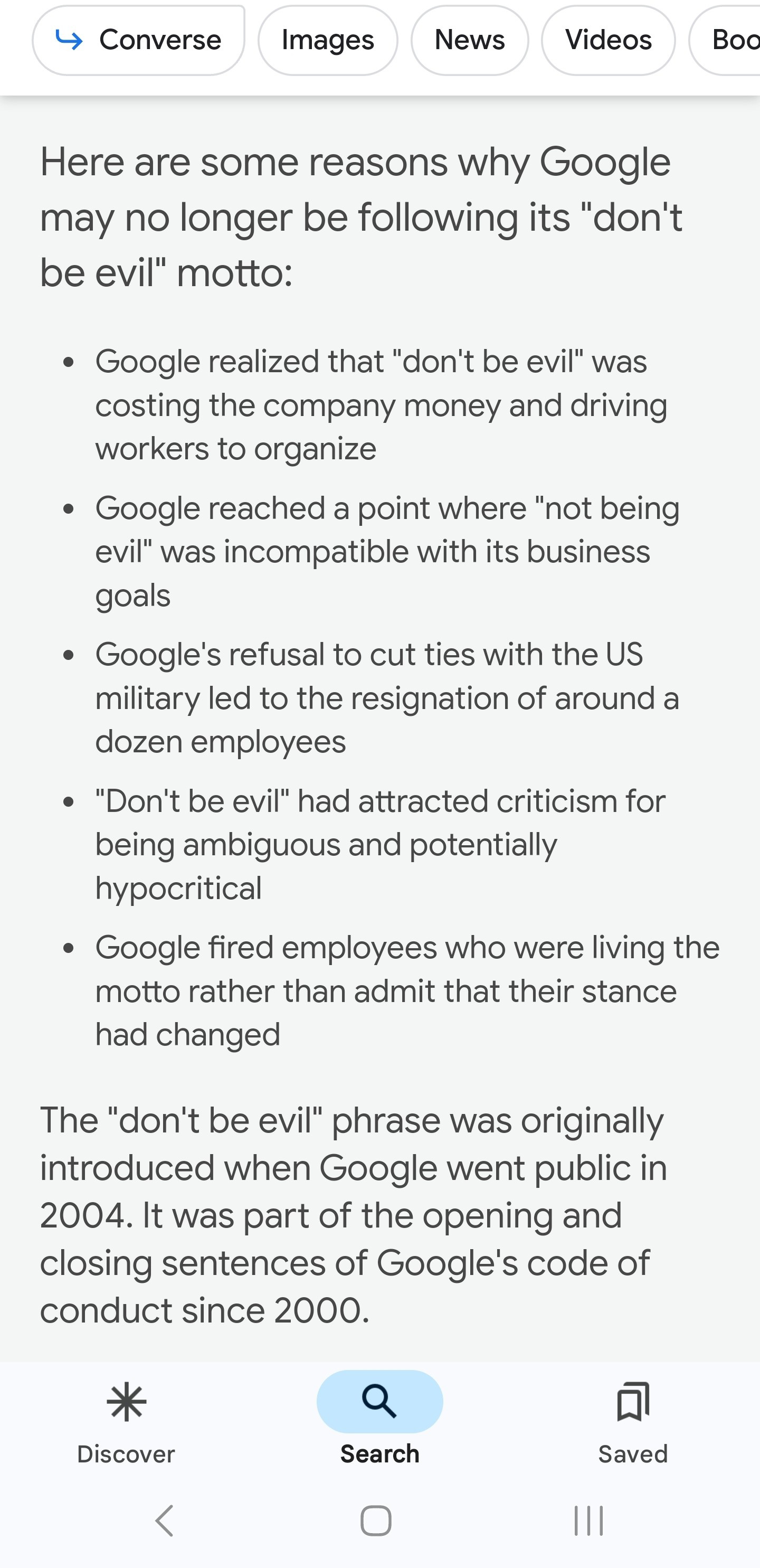

For those not aware, Google is rolling out their new AI-based “Generative AI” search, which seems to mesh Bard with the standard experience.
I asked it today why Google no longer follows their “don’t be evil” motto… The results are pretty hilarious.
I tried to use Bard to write some code the other day, and found it amusing that it doesn’t just make shit up that doesn’t exist, it makes up the excuses as well when you call it out on it’s bullshit.
Like you tell it a particular class doesn’t exist, and it pulls an old version of the compiler out of it’s arse and tells you it was deprecated in that.
AI doesn’t know where it’s limits are. It’s incapable of saying “I don’t know”. They have invented a digital politician.
They’re about to
kill -9the AI process that wrote this and make all the other processes watch.Haha,
kill -9all Google processes, and the little daemons they rode in on too.Just added it to the massive Google graveyard next to Stadia, wave, hangouts, plus, music, etc etc
“kill” (stopping a software process) okay,
… but what’s the “-9” here ?Kill is the main command and 9 is the specific signal. Google SIGKILL
More specifically kill normally sends a SIGTERM which is the equivalent of clicking the X button in Windows. It’s a polite request that the program close itself. Signal 9, also known as SIGKILL shuts the program down immediately and is the equivalent in Windows of opening the task manager and pushing the end process button. It terminates the program immediately without giving it any time to do anything it might still have pending, but in the event that the program is unresponsive might be the only way to successfully close it.
I asked Bard the same “don’t be evil” prompt and this is the reply (they have an option to shorten the response but I didn’t use it):
-Google’s “Don’t be evil” motto was removed from the company’s code of conduct in April 2018. There are a few reasons why this may have happened.
-The meaning of “evil” became too ambiguous. The phrase “Don’t be evil” is open to interpretation, and what one person might consider evil, another person might not. This ambiguity could have led to confusion and disagreement within the company about what the motto meant and how it should be applied.
-Google’s business grew and its operations became more complex. As Google grew, its business became more complex and its operations had a wider impact on the world. This made it more difficult for the company to adhere to a simple motto like “Don’t be evil.”
-Google faced criticism for its business practices. In the years leading up to 2018, Google faced criticism for a number of its business practices, including its handling of user data, its involvement in the Chinese government’s censorship program, and its work on developing autonomous weapons. This criticism may have led the company to believe that the “Don’t be evil” motto was no longer an accurate reflection of its values.It is important to note that Google has not completely abandoned the “Don’t be evil” motto. The phrase is still included in the company’s code of conduct, and it is still used by some Google employees and executives to describe the company’s values. However, the removal of the motto from the preface of the code of conduct suggests that Google no longer sees it as the defining principle of its business.
In its place, Google has adopted a new motto: “Do the right thing.” This motto is more specific and less ambiguous than “Don’t be evil,” and it is intended to provide guidance to Google employees as they make decisions about the company’s business practices.
Reason number one: it’s a publicly traded American company.