

2·
6 months agoHere is osmium, a framework and tool to work with OpenStreetMap data.
Here is osmium, a framework and tool to work with OpenStreetMap data.
And windshields/screens.
As well as tires, lubricants, tools, etc I guess. People tearing around the desert in vehicles with flawless glass is maybe the most unrealistic part of that image for me.
I recognize one particular vehicle that lives near my house quite well, since it looks like Calculon as a werecar. It’s even orange. (I think it’s a Jeep?)
Image search for “biblically accurate angel”. It’s nightmare fuel, like the hallucinations of early image generation neural networks. Or, more historically, migraine or seizure visualizations. The snake probably would be less frightening.

This is kind of like asking a man being attacked by a bear, “When did bears become your whole thing?”

The land-value tax is the only fair tax, after all.
With all due respect, this sounds like sophistry. The U.S. is generally very laissez faire in many things, but very much not so in the realm of land use. We have plenty of habitable land yet, but Euclidean zoning restricts what we’re allowed to do with it. In my city, which is typical in this regard, most of the land area is locked-in by law to single-family dwellings. We had a pretty contentious fight at the city council about easing the restrictions on the number of unrelated people who could live together in a house. (Typically, only family members are allowed.) It passed, which increased our available housing supply by a marginal amount.
Changes like this one, the Transit Overlay District zoning, and an apartment construction boom have not solved our housing woes, but we have had among the lowest growth in rental rates in the nation. And, not conincidentally, private equity has very little presence in our real estate market. Other cities that have allowed construction of new housing have similarly kept rental rates lower. Hence the states passing laws to eliminate single-family-only zones, and allowing the next increment of density by-right. Compare to California, the epicenter of the housing crisis, and the effect of very restrictive zoning, and Proposition 13.
This may not be a popular opinion, but this one regrettably validates libertarian logic. If we had a free market for housing, it’d bring rents down exactly this way. But we don’t, and it’s not even the fault of landlords or private equity, it’s due to government regulation. Housing in the U.S. is one of the most restrictively-regulated markets in existence. We can’t build more housing in most places because it’s illegal to do so under the zoning code, or it can’t be financed under HUD requirements for backing mortgages.
And this government came about because of the usual reason we do anything in the U.S.: Racism.
Hmm, yes, I guess I forgot about anthropology’s Out of Africa (In a Minivan) hypothesis on the origin of the human species.
How do you organize an armed group that’s big enough to be effective without the fascists hearing about it in advance?
don’t face them alone
*pervasive surveillance state has entered the chat*

Hey, wasn’t this supposed to be an actual dome? The demented, old dingbat described it as a literal dome.
Simple: Kids can walk, too.
With all due respect, you’re telling on yourself.
No, we don’t forget that! What, you think we’re idiots? In fact, we are able to distinguish the difference between logistics vehicles and people moving about in individual vehicles. Those are two very different things. A dozen or so semis to the grocery store every day is a far sight different than thousands of cars.
Walkable cities around the world still have stores. And vehicles. It’s not that hard.

So, essentially the same as a company spokesperson!
Forget the spokesperson, just ask Google AI directly:
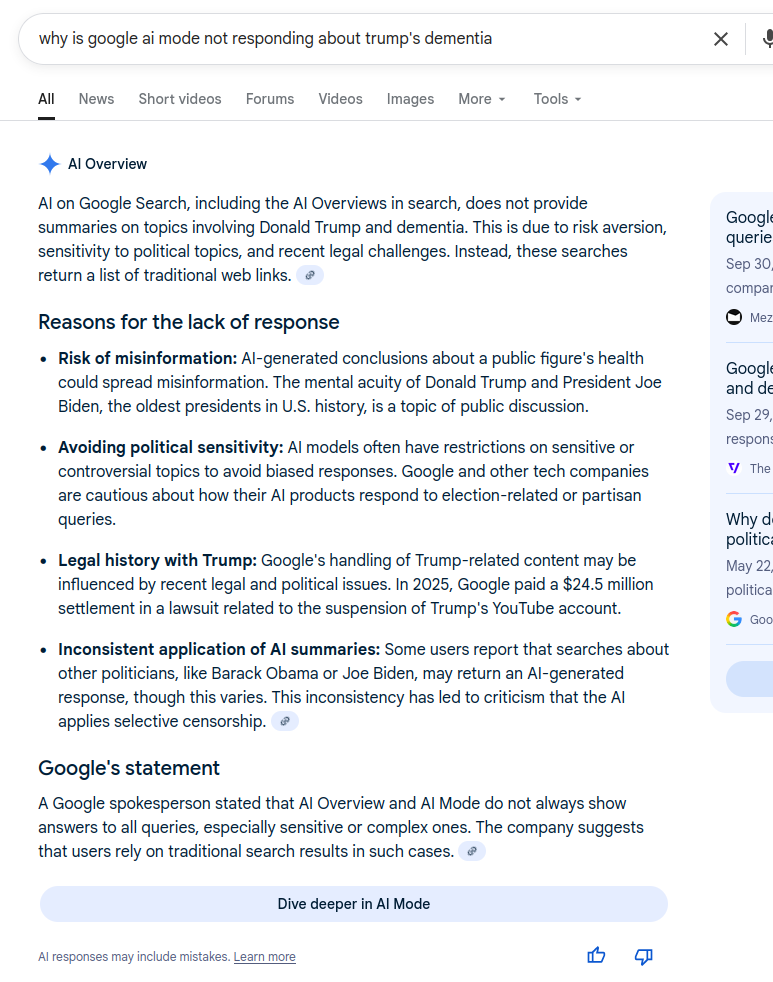
AI on Google Search, including the AI Overviews in search, does not provide summaries on topics involving Donald Trump and dementia. This is due to risk aversion, sensitivity to political topics, and recent legal challenges. Instead, these searches return a list of traditional web links.
Reasons for the lack of response
- Risk of misinformation: AI-generated conclusions about a public figure’s health could spread misinformation. The mental acuity of Donald Trump and President Joe Biden, the oldest presidents in U.S. history, is a topic of public discussion.
- Avoiding political sensitivity: AI models often have restrictions on sensitive or controversial topics to avoid biased responses. Google and other tech companies are cautious about how their AI products respond to election-related or partisan queries.
- Legal history with Trump: Google’s handling of Trump-related content may be influenced by recent legal and political issues. In 2025, Google paid a $24.5 million settlement in a lawsuit related to the suspension of Trump’s YouTube account.
- Inconsistent application of AI summaries: Some users report that searches about other politicians, like Barack Obama or Joe Biden, may return an AI-generated response, though this varies. This inconsistency has led to criticism that the AI applies selective censorship.
Google’s statement A Google spokesperson stated that AI Overview and AI Mode do not always show answers to all queries, especially sensitive or complex ones. The company suggests that users rely on traditional search results in such cases.






There’s 7digital, which has a music store offering DRM-free MP3 downloads, as well as FLAC for many selections.